Scriba — Treasury and Virtual CFO · Synextia Srl
Skip to content

Product sheet · version 1.0

Scriba

Knowing your bank balance is not governing cash. Governing it means seeing the coming weeks and months — with time left to decide.

01 · Two sections, one engine

Treasury calculates. The Virtual CFO interprets.

The number is the same: neither side recalculates the other's figure.

7 views

Treasury

How much cash comes in and goes out over the coming weeks, and how the year closes.

  • Overview and ten-day cash flow
  • Open items, customers and suppliers
  • Open orders, advances, bills
  • Bank balances and credit lines
  • Manual entries and cash budget

7 screens

Virtual CFO

The same figures read the way a CFO would read them.

  • Dashboard: the five numbers of the month
  • Liquidity: 3 to 12-month trajectory
  • Revenue and forecast
  • Receivables and collections: recovery priority
  • Budget, simulator, configuration

02 · How much cash, and when

Ten days at a time

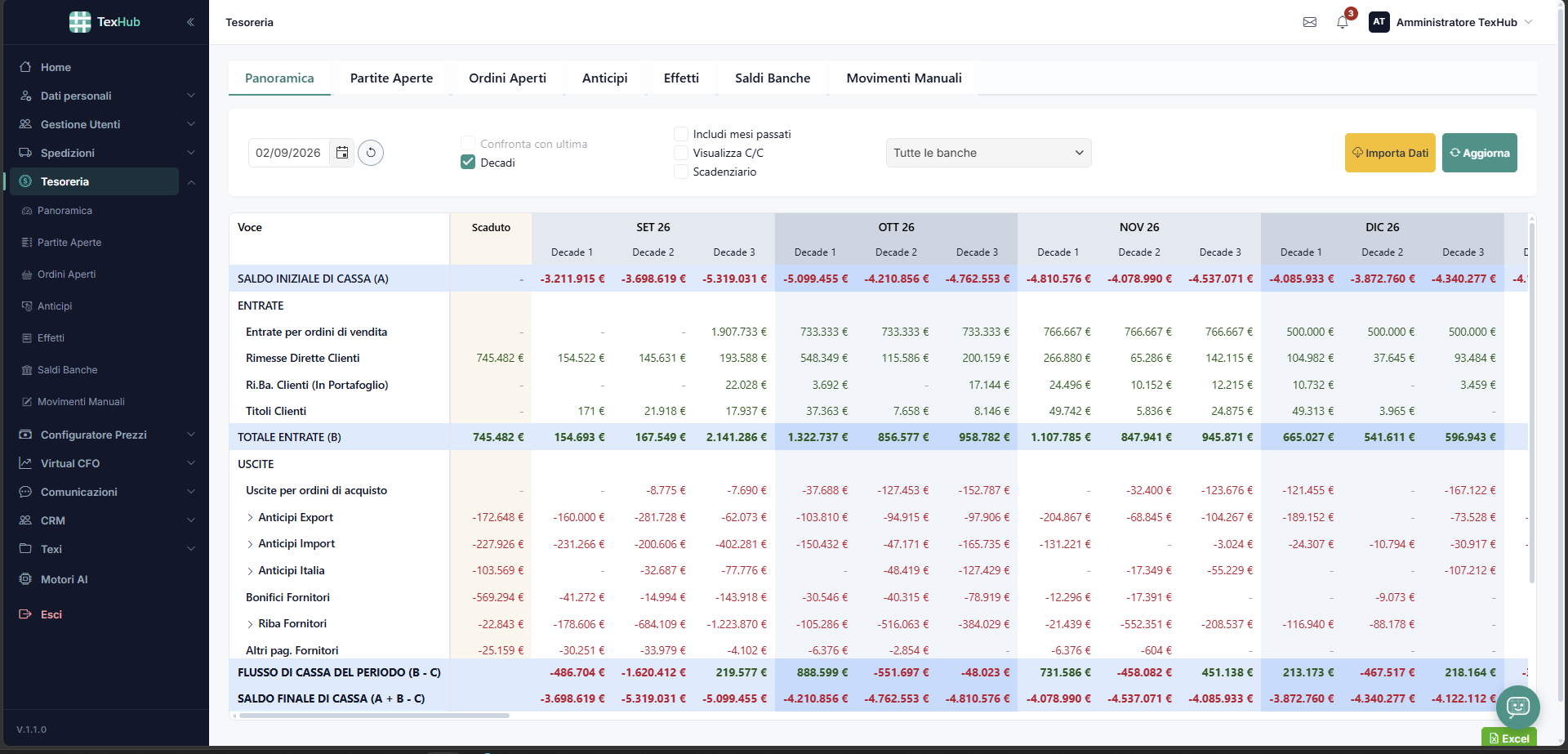
One single matrix: line items in rows, ten-day periods in columns. Opening balance, inflows, outflows, period flow and closing balance. Ten days is the step at which a payment is decided — a whole month is too coarse to tell whether cash holds.

Every cell opens up: underneath are the items that make it, with company name, due date, bank and amount. Filters by bank and accounting due-date ledger, and Excel export of whatever is on screen.

The month in five numbers · illustrative example

1,6
months of cover from the order book
136
average days to collect on 12-month revenue

Illustrative values. The twelve-month cash trajectory comes from the same ten-day treasury periods, aggregated by month, with the low point marked.
03 · What changes in the business

Whoever runs the cash stops building numbers and starts deciding with them

Today, without Scriba

  • The cash plan is a sheet only one person knows how to update.
  • Overdue debt surfaces when the customer fails to pay a second time.
  • How much credit line is left has to be asked of the bank.
  • The budget lives in a different file from treasury, and the two drift apart.
  • "What happens if revenue drops 5%?" gets answered on instinct.

With Scriba

  • The cash plan is a screen: open it, filter it, export it.
  • Overdue debt is at the top of the list, ranked by how much it weighs and for how long.
  • Granted, used and remaining credit per bank sit on the same row.
  • The budget is treasury's own: one budget, for everyone.
  • The question is answered by moving one lever and reading the EBITDA.

04 · Forecasting

A forecast that declares its own error

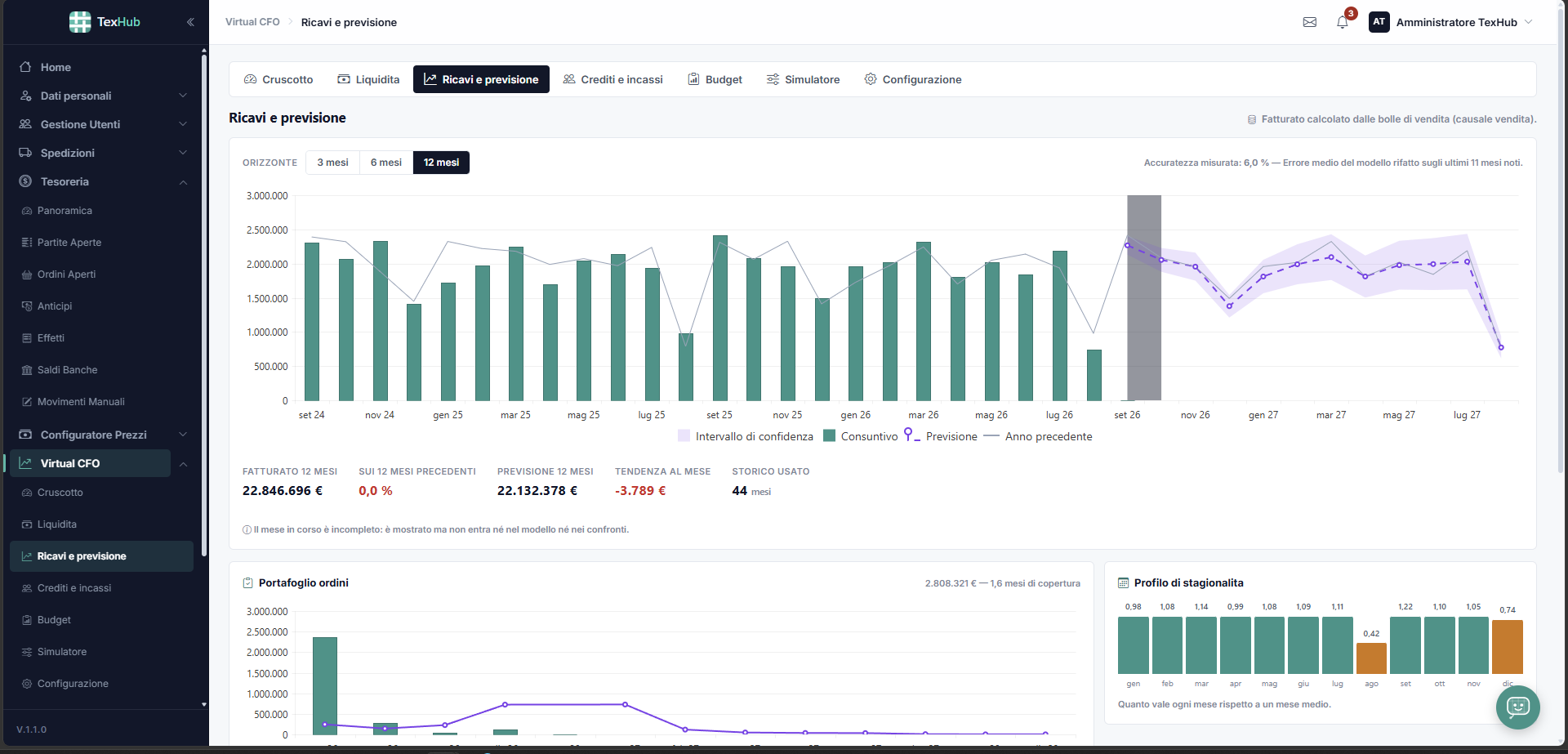
Actuals, previous year and a 3, 6 or 12-month forecast with a confidence interval. Alongside sits the accuracy measured by re-running the model on months already known — and the current, incomplete month stays out of the comparisons.

05 · Receivables

Who to call first

Ageing splits receivables into bands, from not-yet-due to over 90 days, and does the same for supplier payables. Recovery priority ranks customers by overdue amount weighted on days late: the Monday morning phone call is the first row.

06 · Simulator

Levers, not assumptions

The levers are the real ledgers of the company's chart of accounts. Move a revenue line and the costs tied to it move with it: the effect on EBITDA, EBIT and the bottom line appears as you drag, separating what is decided from what is induced.

07 · The screens

Treasury and the Virtual CFO, as they look

Treasury overview: opening balance, inflows, outflows and cash flow by ten-day period
Treasury · Cash flow by ten-day period, from opening to closing balance.
Virtual CFO: twelve-month revenue and forecast with confidence interval and measured accuracy
Virtual CFO · 12-month revenue and forecast, with its accuracy declared.

Half an hour of demo, on your own cash.

Bring an extract of open items and bank balances: we will show you your own treasury, not a catalogue of examples.

Request a demo